Why AI Can’t Write History
An AI wanted to write Yellowstone history for me. Here’s what went wrong, and why it matters.
By John Clayton
“Sure,” I said silently to my website provider, “show me the competition.” It wanted to show me some free, AI-generated blog posts for my website. Since I’m a writer myself, it was potentially intimidating. How close could an AI get to replacing me?
The answer: not very. I skimmed through most of its proposed posts thinking, “Egad this is dreck.” Bland, pointless, humorless. Then I came across a draft titled “Discovering the History of Yellowstone.” (The AI came up with SEO-friendly topics based on the content of my website; I’ve written a book and numerous articles about Yellowstone.)
Here I found my reactions more extreme. I was horrified at the text’s factual errors. They weren’t the well-known “hallucinations” of AI, such as inventing characters or journal articles to support an argument. Worse: they were more subtle. The errors were evidence that the AI wasn’t actually thinking.
Let me explain with some examples.
- “Tribes like the Shoshone, Crow, and Blackfeet roamed these lands, hunting bison and living in harmony with the natural wonders around them,” the AI wrote. Well, sort of. Inside Yellowstone’s boundaries before 1872, the wildlife mix was different than today. The only Indigenous people to live there fulltime were Shoshone bands called Tukudika, “sheep eaters.” They hunted more bighorn sheep than bison. Indeed they centered their lifestyles around that choice, for example not bothering to own horses in the mountainous terrain.
It’s easy to see how the AI goofed. Crow, Blackfeet, and other tribes did roam these lands and did hunt bison, though most of that bison-hunting happened elsewhere on horseback. It’s the sort of error an intern might make—but the point of hiring an intern is that when you correct the error, the intern learns and grows. When you correct an AI, it just blathers on.
- “[I]t wasn’t until the 1860s that serious scientific expeditions started to document Yellowstone’s unique geothermal features,” the AI wrote. Serious? Scientific? The Folsom-Cook expedition of 1869 was, according to historian Louis Cramton, the “first real exploring expedition in the Yellowstone Park region, of which anything like a complete and authentic report is preserved.” However, Folsom and Cook weren’t scientists. An 1870 expedition did more mapping and naming, but the real scientists didn’t arrive until 1871.
It’s hardly a significant error. A couple of years, a couple of adjectives. Still, it’s a novel misinterpretation of a longstanding source (Cramton was writing in 1932). One would hope that progress in history could reduce errors rather than introducing new ones.
- “Harry Yount, who is often credited as the first official park ranger in the United States[:]… His job was tough, but his dedication helped lay the groundwork for the National Park Service, which was established in 1916,” the AI wrote.
Transitions! Harry Yount has an interesting story, which the AI clumsily summarized. His focus on wildlife influenced the philosophy of later rangering within NPS. But it feels like the AI found two facts (Yount; NPS founding) and made an awkward transition that incorrectly implied causation.
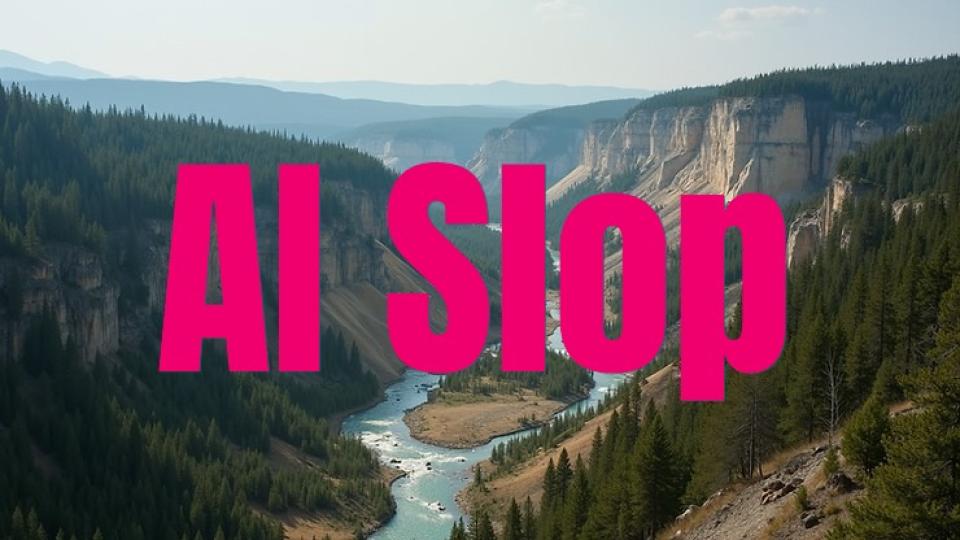
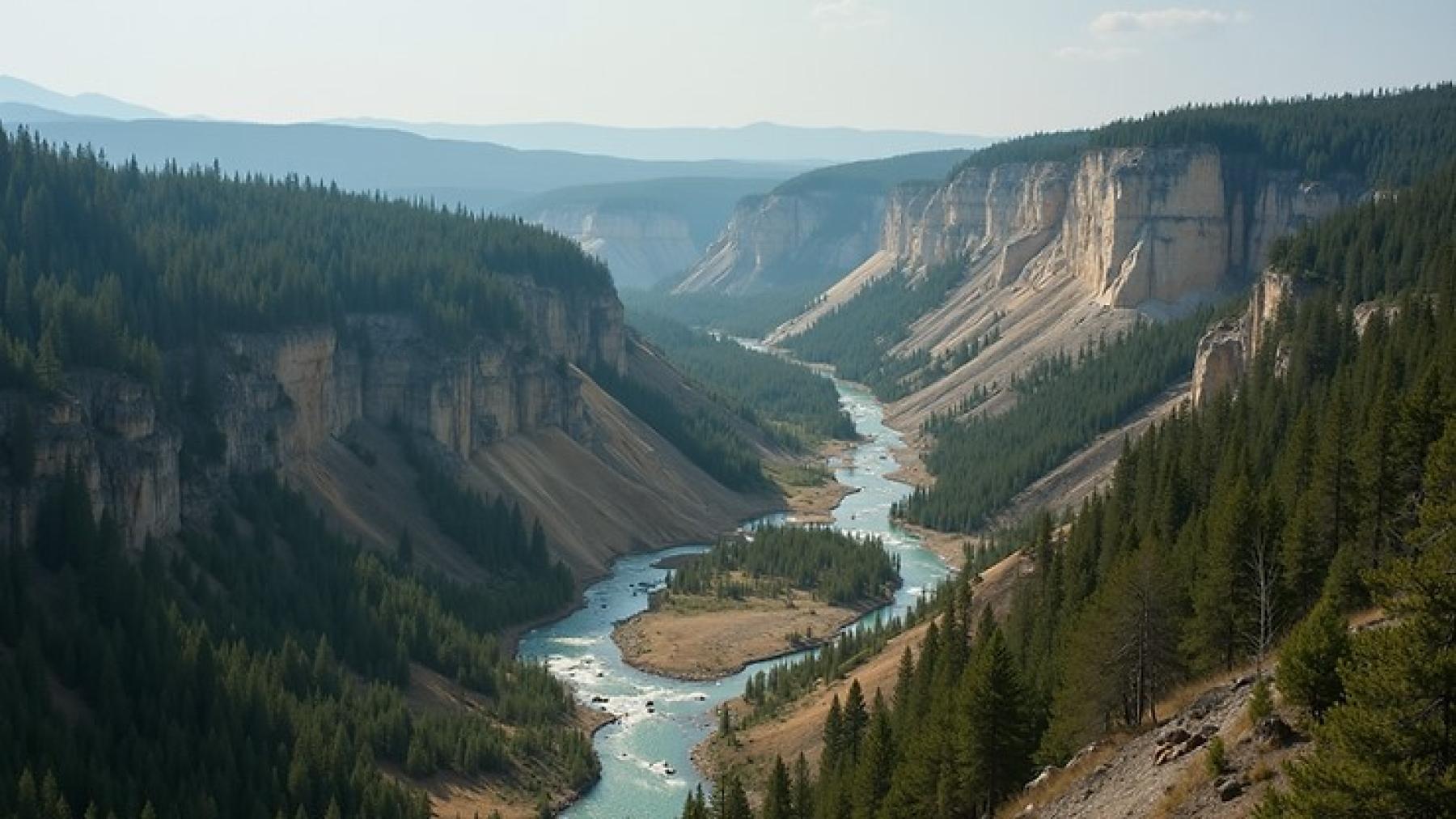
- “Yellowstone’s diverse natural landscape,” the AI captioned the picture atop this essay (minus my “AI Slop” label, of course).
However, this is an AI-generated image. It’s not an actual landscape, in Yellowstone or anywhere else. The AI suggested two other images for its blog post: “Yellowstone’s geothermal wonders” (apparently showing Grand Prismatic Spring) and “Old Faithful geyser eruption.” Both were AI-generated images rather than photographs. When I put the second one into Google’s image search, it waffled between locating the geyser in Yellowstone or in Iceland.
Maybe I’m just being nit-picky; maybe my website provider chose a particularly lame AI. But I present these examples in detail because, to date, I mostly hear two types of complaints about AI. First: teachers worried that students would submit this stuff instead of learning. Second: Internet users rightly characterizing this stuff as AI slop that wastes their time. My complaint is different: AI is bad at its job.
In this story, I am neither student nor consumer. I am an entrepreneur. I run a website that I use to sell books. My business partner—the website provider—offers me a tool to make more money. But the tool is garbage. Shortcuts in logic, mischaracterizations, boneheaded transitions, and visual lies will never help me sell more books.
Granted: the AI technology will improve. Granted: businesses (and even writers themselves) will become smarter about how to take advantage of it. But to me, the lousy Yellowstone-history blog post epitomized the disconnect we’re all feeling between our everyday lives and this bizarre AI-driven stock market boom.
Everyone “knows” that businesses will use AI to make money. But if it can’t even do so for Wonderlandscape, doesn’t the same hold for bigger, better businesses than mine?
This article first appeared on John Clayton’s Substack, Natural Stories, and is reprinted here with the author’s permission.
More about Yellowstone history:
- Yellowstone, The World’s Wonderland
- Alice Morris: Mapping Yellowstone’s Trails
- Yellowstone Park, Arnold Hague and the Birth of National Forests
- The Annie, First Sailboat on Yellowstone Lake
- John Muir in Yellowstone
- The President Arthur Expedition: The Fishing Trip That Helped Save Yellowstone
- William Henry Jackson: Foremost Photographer of the American West
- “Let Us Ramble:” Exploring the Black and Yellow Trail in Wyoming
- Wyoming Parkitecture
- Conservation politics: ‘Triple A’ Anderson and the Yellowstone Forest Reserve
- Hard Times and Conservation: the CCC in Wyoming
- The 1959 Lake Hebgen Earthquake and its Effects on Yellowstone Park Geysers
- Modernizing National Park Facilities: Mission 66 in Wyoming
- National Parks, Science and the 1963 Leopold Report
- The Yellowstone Microbe That Changed the World
- Yellowstone Ablaze: The Fires of 1988