The Civil Rights Movement Comes to Casper
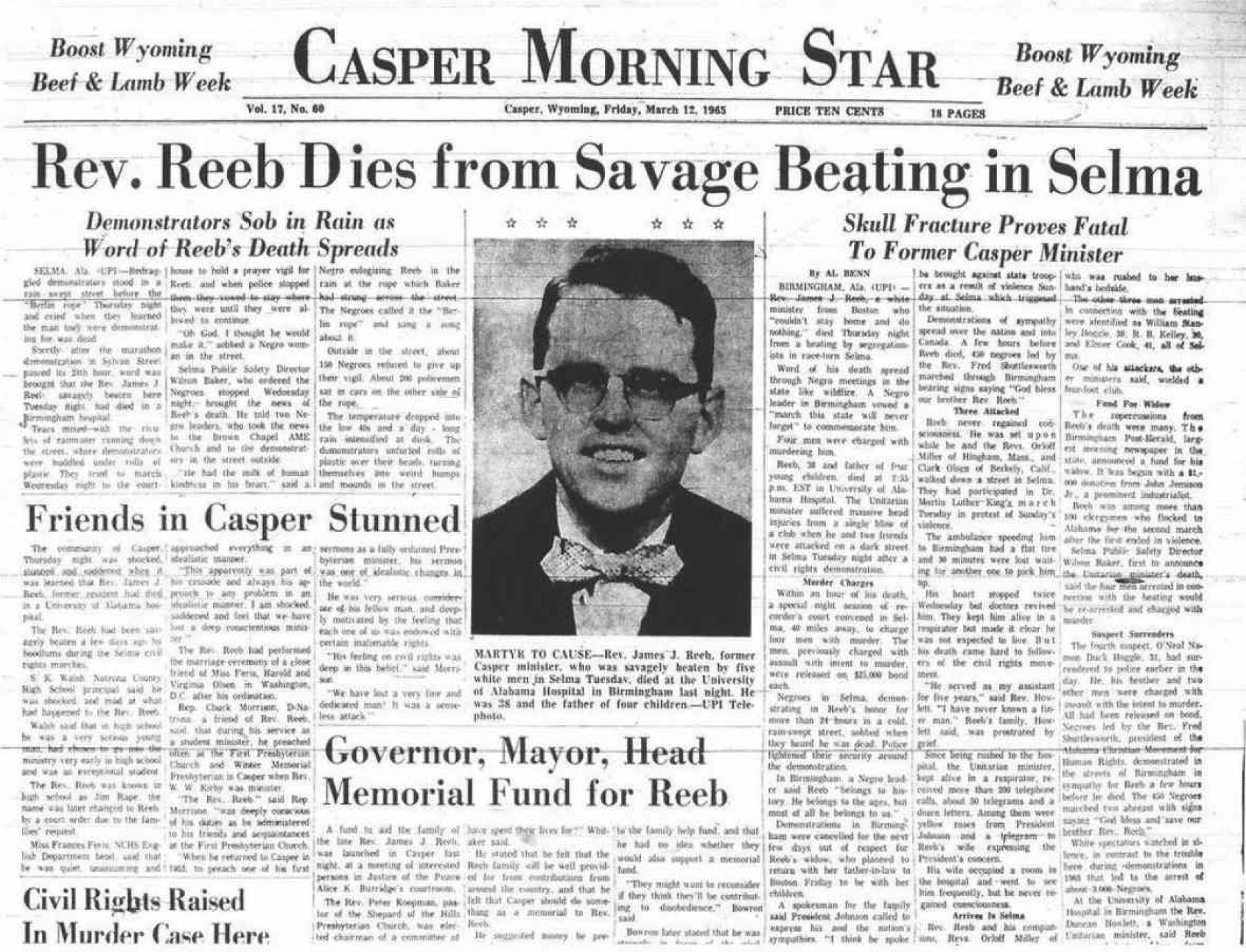
“The tragedy of violence and racial tension in Selma seemed remote to residents of this community until the shocking death of the Rev. James J. Reeb, a former minister from Casper.” This sentence began the March 12, 1965, editorial in the Casper Morning Star and showed how the murder of Rev. James J. Reeb brought the civil rights movement to Casper, making the larger national events personal.
On March 9, 1965, activists gathered in Selma, Alabama to voice their support for voting rights for Black Americans. Activists from all around the country made the journey to Selma to join civil rights leaders for the demonstration that was in response to the violence during the Bloody Sunday march on March 7.
On the evening of the 9th, three white clergymen who participated in the demonstration were attacked by three men. One of the critically injured was Rev. James Reeb who had traveled from his Boston home to support the march for voting rights. Reeb’s injury quickly drew attention in Casper because of his connection to the city. His family had moved to Casper during Reeb’s teenage years, where he attended Natrona County High School.
Even though he had moved to the East Coast during the 1950s, he still had many community ties in Wyoming. His parents still lived in the town, as did his in-laws. After his military service during World War II, Reeb attended Casper College where he met his wife, Marie. At the time of his death, the family had been living in Boston, Massachusetts, since the fall of 1964 when Reeb had started working with the American Friends Service Committee, a Quaker-founded organization working for peace and social justice in the United States and around the world.
For many in Casper and Wyoming, in a larger sense, the murder of Rev. James J. Reeb was the first time the civil rights movement became personal—more than just a headline in the newspaper or a passing mention on the local news. This was someone many Casperites knew from school, or they knew of his parents or his in-laws. Casper had not been totally isolated from the movement. In August 1960, the local NAACP (National Association for the Advancement of Colored People) had reorganized with 83 senior members and 20 youth members. They met 10 times throughout the year and focused on education about local and national issues. They continued to be active through Reeb’s murder and contributed to the organization of the local memorials.
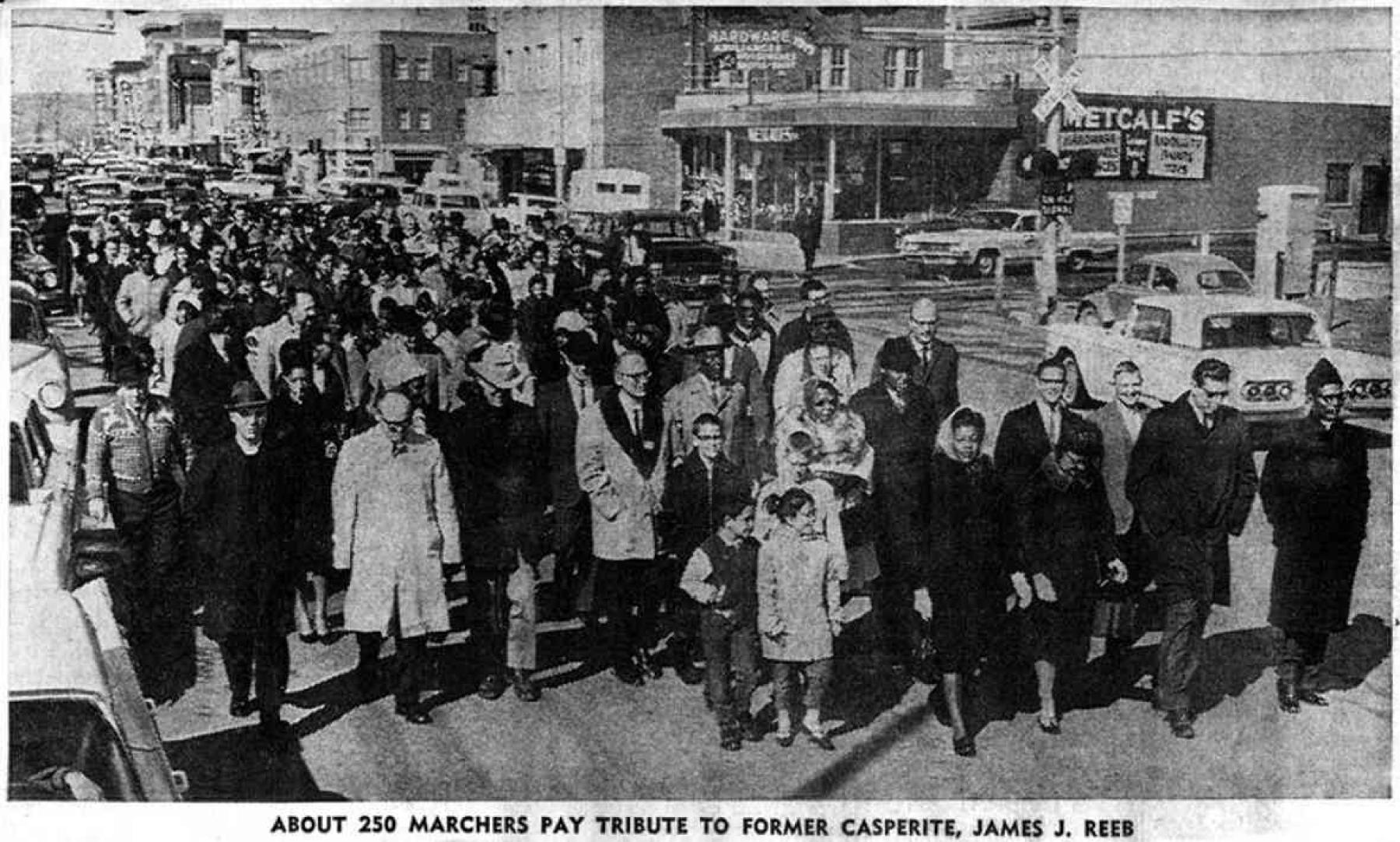
The national story became a local one that Casperites could put a face to. The tragedy brought the civil rights movement to the Casper community and led to increased attention to activism in the South and nationally. The two Casper newspapers, the Casper Morning Star and the Casper Tribune, covered the murder of Rev. Reeb and the aftermath. Both newspapers condemned the violence regardless of readers’ views on the movement; the Casper Morning Star wrote that “violence and brutality cannot be condoned.” The front pages of both newspapers were filled with articles about the initial attack on Reeb as well as status updates on both his condition and on the arrest of the men who attacked him.
The newspapers also devoted editorial space to Reeb and the larger movement. The Casper Morning Star did not publish as many editorials about the attack on Reeb, but the one they did shortly after the March 9 attack on Rev. Reeb, Rev. Clark Olsen, and Rev. Orloff Miller showed the deep connection that the Casper community had to Rev. Reeb. The Tribune continued the trend of memorializing Reeb but remaining somewhat neutral on the larger movement. In a March 21, 1965, editorial about the memorial service, the editors summed up their stance by pointing to the personal decisions that drove one to participate in the movement by advocating that “all debate, all argument must be set aside” and then asking, “What man shall advise another how to fulfill his duty of humanity, how to be true to his noblest thoughts and his deepest emotions?”
While it might not have been the intention of the newspapers, the uptick in coverage of the movement, particularly the continuing fight for voting rights and activism in Selma, served as an opportunity to educate the community about the fight for civil rights and voting rights. We can get hints about how Casper residents viewed the civil rights movement in the wake of Reeb’s death. Many of the articles about the movement for voting rights and civil rights were UPI articles (United Press International) that were printed in numerous newspapers around the country. It is insightful to see which UPI articles were included in each paper and how many articles were included that provided information about national civil rights events to their readers. The editorials in each paper provide a more local perspective of the events in Selma and the larger campaign for the Voting Rights Act by President Lyndon B. Johnson and Congress.
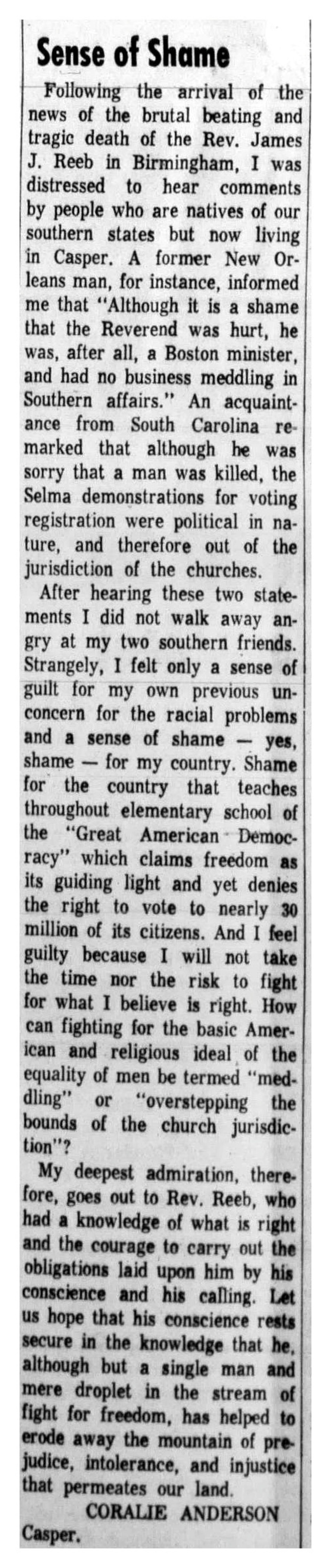
Of particular interest are the letters to the editor published in the Star Tribune. The subjects of the letters vary with some individuals commenting on the paper’s editorials but some just wanting to offer their ideas about future actions to remember Reeb. The March 14, 1965, edition of the Casper Tribune included a letter to the editor from Casper resident Coralie Anderson titled, “Sense of Shame.” Anderson relates two conversations with acquaintances who had previously lived in the South and had dismissive thoughts regarding the Selma march. She admitted that while not angry, their responses brought about shame and their reactions caused her to rethink her own knowledge of what was occurring in the South and the needed push for change. Anderson wrote, “I felt only a sense of guilt for my own previous unconcern for the racial problems and a sense of shame—yes shame—for my country.” The killing of Rev. Reeb had not only caused her a sense of loss and guilt, but a new desire to think about the larger movement and through the writing of the letter, she contributed to the discourse and conversation about civil rights in the Casper community.
One pervasive thread following Reeb’s death was the involvement of preachers and clergy (especially those outside the Southern states) in the movement and how they were inserting themselves into a fight where they did not belong. While the inclusion of religious leaders might have proved controversial for some, the clergy themselves did not hesitate to answer the call by Martin Luther King, Jr., on Monday, March 8th for clergy from across the nation to meet in Selma to march. Reeb’s biographer and colleague, Duncan Howlett, told of Reeb’s immediate desire to join the march and support the activists. Clergy from all over the country traveled to Selma and joined the march.
This would not be the last time that Martin Luther King, Jr., would mobilize clergy from across the nation to support the movement. It was also not the last time Casper natives would heed the call. The March 25, 1965, edition of the Casper Tribune reported that Robert Nunn, a second-year theology student at San Francisco Theological Seminary from Casper, was traveling from San Anselmo, CA, with other seminary students to Selma to participate in another march for voting rights. There is no mention of Reeb in this article, but there is mention that Nunn’s decision to participate was supported and encouraged by faculty members from the seminary who themselves had just returned from Selma.
While the news coverage of the movement began to decline towards the end of March, there were regular updates on the status of the fund organized in the wake of Reeb’s death. Beyond the initial purpose of supporting the Reeb family, there were differing ideas of what the money would be used for and how it would memorialize Reeb. Decisions about how to memorialize Reeb were not publicly released during the immediate aftermath of his death, but there was one Casper resident who put forth his ideas in a letter to the editor. Albert Honack proposed that, “A start [for a memorial] would be to forget our stagecoach, cowboy, Indian, oil boom up-and-down heritage and enter into a new era of cultural advancement and worldwide affairs and build a Rev. Reeb Civic Center in Casper…” Honack went on to detail how there could be annual seminars and then also that it would be an institution with a reach beyond Casper and Wyoming. He surmised that “Casper and Wyoming could become a focal point of the free world for its study and furtherance of freedom and equal rights for many years.”
Although these ideas didn’t come to fruition, this proposed center and the ideas of how the memorial fund could remember Reeb’s work and legacy are another example of how his death provided the opportunity to educate the community about the civil rights movement and increased dialogue about the need for change.
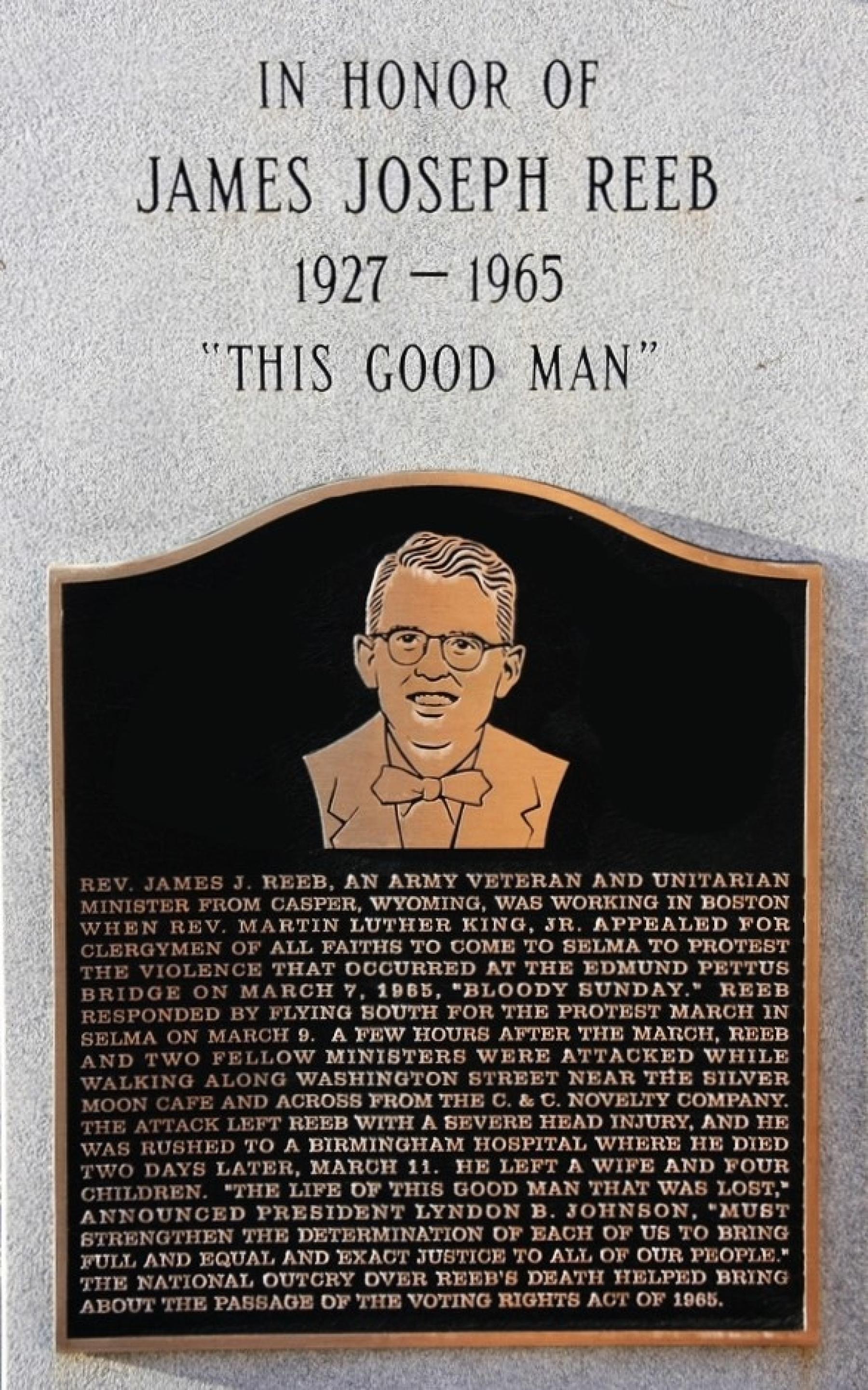
Rev. Reeb’s death shocked the nation and many point to his death as a turning point and resulted in his becoming a martyr for the movement. His death brought the civil rights movement to Casper, and the community mourned his death alongside his family and the rest of the nation.
His murder also increased awareness of the movement, its methods, goals, and the fight for racial equality. In the aftermath of his death, many pointed to the courage of Reeb whose involvement in Selma was just a part of his work against social injustice and set an example for others not to just observe injustice, but to act against it.