Wyoming’s history comes alive through the voices of those who lived it. This collection features oral history interviews from repositories across the state, preserving firsthand accounts of Wyoming’s people, places, and events.

Each oral history identifies its source repository and includes audio recordings and transcripts.

This is a growing collection. WyoHistory.org welcomes partnerships with Wyoming repositories to share oral histories with wider audiences.
Latest Oral Histories

Four years after finishing his second term as governor of Wyoming, Mike Sullivan was named U.S. ambassador to Ireland. Sullivan arrived in Dublin in 1999, when the ink was barely dry on the Good Friday Agreement, bringing peace in Northern Ireland after three decades of disastrous bombings, murders and political stalemate.

In May 1950, Louise Spinner Graf served as foreman on the first Wyoming jury, with one minor exception, to include women since 1871. Born in Green River, Wyo., she attended university and worked in local banks. After marrying George Graf in 1930, she quit working to raise their daughter, and remained active in the community the rest of her life.

In 1905, Caroline Fuller came to Thermopolis, Wyo., and entered a field usually reserved for men—dentistry. How she came to take dental impressions and pull teeth for sheep barons and cowboys in remote parts of Wyoming is only one phase of her interesting life.

Frank Shepperson has ranched with his family northwest of Casper, Wyo., for many years. In this 2014 interview, Shepperson, a former national rodeo champion, talks at length about rodeo, ranching—and airplanes. He is a past president of the Wyoming Stock Growers Association and former chairman of the Natrona County School Board.

Oleta Thomas often visited the Heart Mountain relocation camp as a teenager during World War II, when her father had a job there. In this 2012 interview she remembers those times and later ones as a home ec teacher in 1950s Cody and a massage therapist in Casper since the 1980s.                    

Edna Garrett was born in Salt Creek, Wyo., in 1926, and grew up with her eight siblings in a house with no running water in a boomtown going bust, where her parents ran a secondhand store. This interview was conducted two years before her death in 2013. 

Former sheepherder, ranch foreman and schoolteacher Henry Jensen was past president of Wyoming’s historical and archeological societies. One day in the early 1990s he and Casper science teachers Dana Van Burgh and Terry Logue drove southwest from Casper to Devil’s Gate, noting all kinds of geology, archeology and history along the way. 

Charlotte Babcock, Casper College class of 1949, shares memories of her life—including stints as schoolteacher, flower-shop owner, book author and community-minded volunteer—with student interviewer Nichole Simoneaux in this March 2012 interview conducted at the college. 

LeRoy Strausner served as the fourth president of Casper College from 1991-2004. In September 2013, Dana Van Burgh interviewed him at the facility’s Western History Center about his life and his long career at the college.

Joye Kading served as secretary for the successive commanding colonels in charge of purchasing, building and operating the Casper Army Air Base during World War II. In this 2011 interview from the Casper College Western History Center, Kading recalls her experiences and describes many of the wartime photographs she collected in a scrapbook.

The popular Republican Thyra Thomson served as Wyoming’s secretary of state from 1963 to 1987, when she retired. While in office, Thomson witnessed the continuing presence of gender discrimination in the Equality State, and became a fierce advocate for equal rights. She died in Cheyenne June 11, 2013. She was 96.

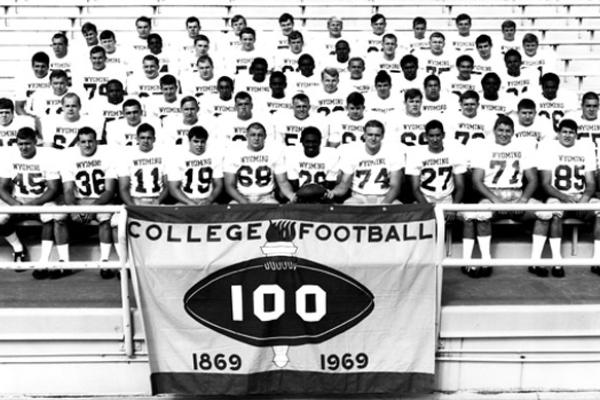
In October 1969, University of Wyoming Head Coach Lloyd Eaton dismissed 14 black football players from his team when they donned black armbands to protest certain policies of Brigham Young University. The incident stirred controversy in Wyoming and throughout the nation. Here, Dr. Willie Black, who was the chancellor of UW’s Black Student Alliance at the time, shares his recollections of those events, and broader thoughts on race and politics in the United States and the world.

In October 1969, University of Wyoming Head Coach Lloyd Eaton dismissed 14 black football players from his team when they donned black armbands to protest certain policies of Brigham Young University. The incident stirred controversy in Wyoming and throughout the nation. Here, player Mel Hamilton shares his recollections of that time and of much of the rest of his life with interviewer Phil White, who was a UW student in 1969 and the editor of the student newspaper, The Branding Iron.

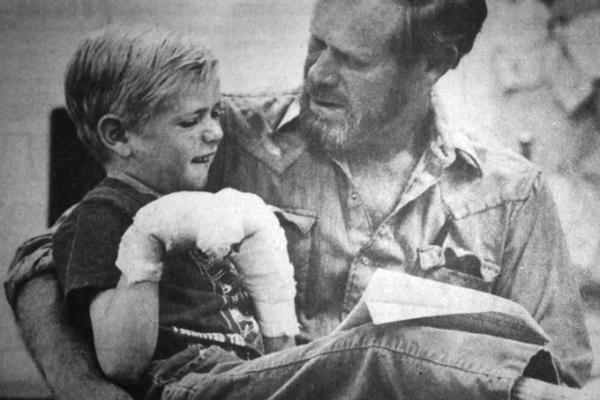
Jamie Buckley King attended third grade at Cokeville Elementary School in Cokeville, Wyo., on May 16, 1986, when David and Doris Young took her and 153 other people hostage at the school, and detonated a bomb inside. The Youngs both died that day. Everyone else survived.

Tina Cook was the secretary at Cokeville Elementary School in Cokeville, Wyo., on May 16, 1986, when David and Doris Young took her and 153 other people hostage at the school, and detonated a bomb inside. The Youngs both died that day. Everyone else survived.

LeaKae Roberts was a fourth-grader who was absent from class at Cokeville Elementary School in Cokeville, Wyo., on May 16, 1986, when David and Doris Young took 154 other people hostage at the school, and detonated a bomb inside. The Youngs both died that day. Everyone else survived.

Ron Hartley was the lead investigator for the Lincoln County Sheriff’s Office in Cokeville, Wyo. on May 16, 1986, when David and Doris Young took 154 people hostage at Cokeville Elementary School, and detonated a bomb inside. Hartley is the father of four student survivors of the incident. The Youngs both died that day. Everyone else survived.

Audio and transcript of interview with former Governor Stanley K. Hathaway conducted by John Hinckley in 1977.

Audio and transcript of interview with former Governor Milward Simpson, conducted by John Hinckley, July 18, 1977, in Cody.

Audio and transcript of Gerry Spence interview conducted by Mark Junge.

Browse Oral Histories by Title

- No value - | A | B | C | D | E | F | G | H | J | K | M | P | R | S | T | V | W
Title Author
Allred, Golden, Bighorn Basin trapper Washakie Museum and Cultural Center

Browse Oral Histories by Location