Guinard’s Platte River Post
Louis Guinard, a French-Canadian trader, built a trading post and bridge on the Sweetwater River in 1857.1 Two years later, rather than operate both sites at once, he abandoned that post and shifted his business entirely to the North Platte, though this was not his first venture on that river. In the fall of 1852, he had been one of five partners—including trader John Baptiste Richard, Joseph Bissonette, Charles Bordeaux, and William Kenceleur—who built Richard’s original bridge at this same crossing. By 1859, Guinard had become Richard’s rival rather than his partner.2 That year, he used profits from his Sweetwater River Post [link to Guinard’s Sweetwater River Post] to construct a new bridge and trading post operation on the North Platte, near Richard’s Post, contracting the work to Joseph McKnight— he same builder Richard himself had long employed—with construction underway by October 1859.3 The new bridge, built at a reported cost of $40,000, stood roughly six miles upstream from Richard’s own long-established bridge and post near present Evansville, Wyoming, in Natrona County.4 Contemporaries distinguished the two by name: Guinard’s was known as the Upper Platte Bridge, and Richard’s as the Lower Platte Bridge — though Richard’s was more commonly called Reshaw’s Bridge, an English mishearing of his French-accented name that stuck.5
The placement of the bridge in this location was unusual, as Richard was already operating a substantial bridge and post compound in the vicinity. There are a couple of explanations for why he did this. Olaf Hagen, a National Park Service regional historian, found there to have been enough traffic through the region to support the operation of two bridges.6 Thomas Nicholas, a Casper-based historian who later led the 1963 archaeological work confirming the location of Reshaw’s Bridge, believed instead that the Guinard Bridge was built to service westbound traffic, allowing wagons to avoid the sandy soils on the hills north of Casper.7 While Guinard’s complex was small, it soon began to capture much of the emigrant traffic through the region.8 However, Guinard’s affiliation to the Shoshone proved disadvantageous to him at this location. The post was located on the eastern fringe of the Shoshone territory.
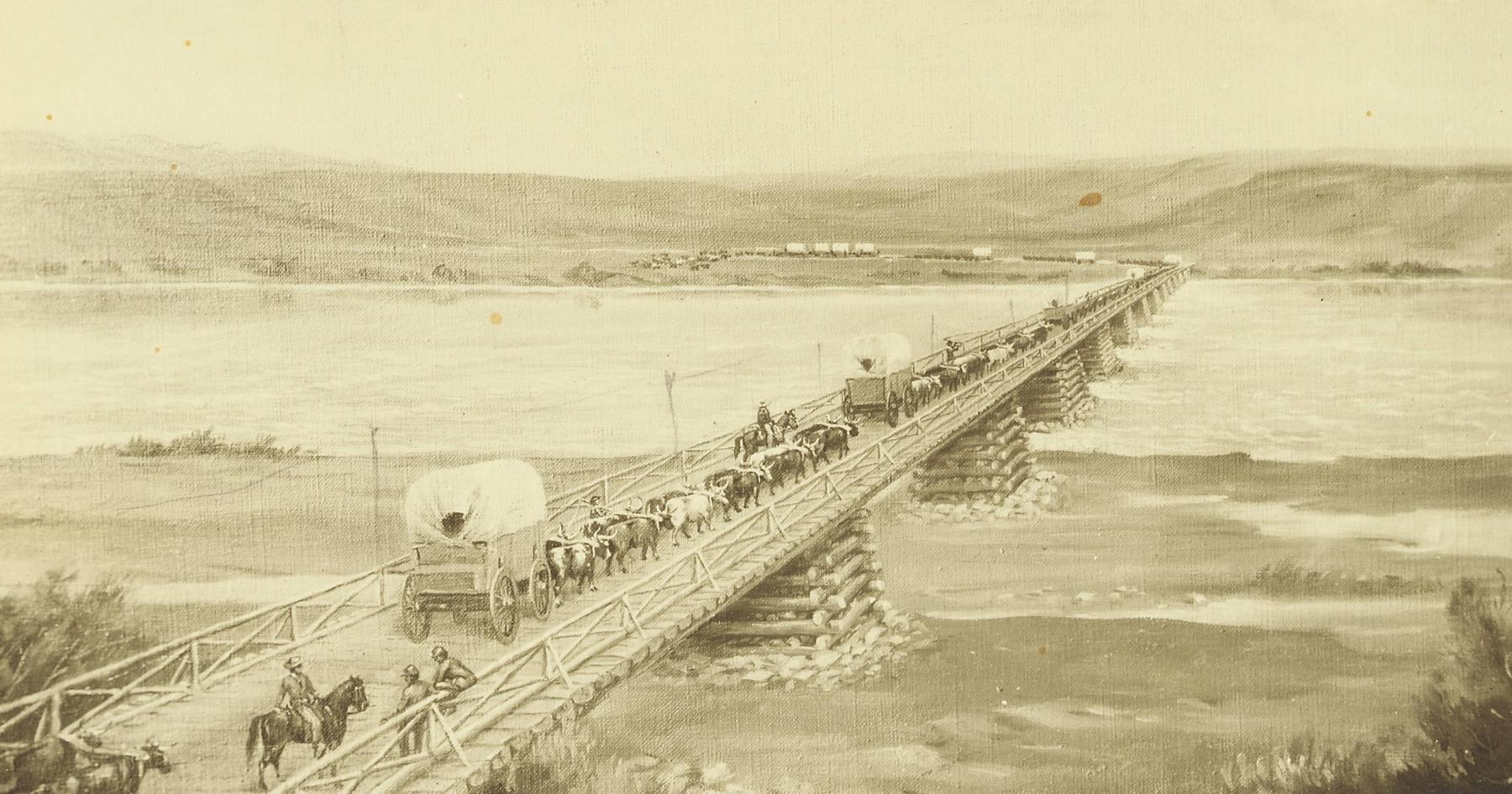
Additionally, his primary competition in the area, John Richard, was related to the Dakota Sioux through marriage. The Dakota were a constant threat to Guinard, frequently stealing from him.9 On October 5, 1860, this hostility turned deadly: Sioux raiders killed one of Guinard’s sons while the boy was out herding horses. Indian Agent Thomas Twiss reported that the boy’s body “bore unmistakable signs that he was shot with arrows, being also much cut and mangled.” Sir Richard Burton, who had visited the post that August, had already described Guinard as “downcast about his temporal prospects.”10 Because of this, and possibly the murder of his son in the area during 1860, Guinard sold his Platte River Post and bridge to John Richard by 1864.11 Richard’s son Louis then ran the trading operation from the former Guinard post through the following winter, until the spring of 1865. By then, tribal retaliation for the Sand Creek Massacre, which occurred on November 29, 1864, had set much of the central and northern plains ablaze with fighting that would culminate on July 26, 1865, in battles at the Platte River Post location. Amid the escalating violence, the Richards withdrew from the Upper Platte trade entirely and established a new post where the Overland Trail crossed Rock Creek, west of the Laramie Plains.12
As the Platte River Post’s importance grew, it accumulated infrastructure in quick succession. Guinard’s bridge was chosen over Richard’s as the site of a Pony Express relay station in 1860, and a stage station remained in operation there until 1862.13 In 1861, the original post house was expanded into a telegraph station.14 An army volunteer unit from Fort Laramie garrisoned Guinard’s Bridge in 1862. The garrisoning company, under Capt. O.W. Van Winkle of the 2nd Battalion, 6th Ohio Volunteer Cavalry, reported to its commander on October 27, 1862: “Have 28 men, 35 horses, 6 mules, quarters and stabling finished and good. 800 bu. corn, 31 tons hay, 50 cords wood.... Have rations to first April.”15 The garrison was known as Platte Bridge Station from 1862 to 1865.16
This Platte Bridge Station should not be confused with Richard’s own, earlier military garrison—known variously as Camp Clay, Fort Clay, Camp Davis, the Post at Platte Bridge, and Camp Payne—which occupied Richard’s bridge, not Guinard’s, and had already been abandoned in April 1859, before Guinard’s bridge was even garrisoned.17 In 1865, Richard sold the property to the military. They began expanding their presence at the site through an increase in the number of troops, the reintroduction of army regulars to the post, and construction of several log buildings. During the peak of the military occupation, there were more than two dozen major buildings and several additional outbuildings meant to house three to four hundred men.18 The new post was known as Fort Caspar. Fort Caspar was abandoned in 1867 and buildings moved to Fort Fetterman.19 A surviving log officer’s quarters at Fort Fetterman, restored by the Wyoming Recreation Commission and Wyoming State Museum, is believed to be built from logs salvaged from Fort Caspar in late 1867.20 Guinard’s Bridge was later destroyed by natives in October 1867, shortly after the site was abandoned.21 This account is disputed: historian Robert Murray called the “burned by Indians” explanation a convenient piece of regional folklore applied to nearly every abandoned military structure in the area, and suggested instead that troops stripped the bridge’s timbers for salvage alongside the rest of the post’s materials in 1867.22
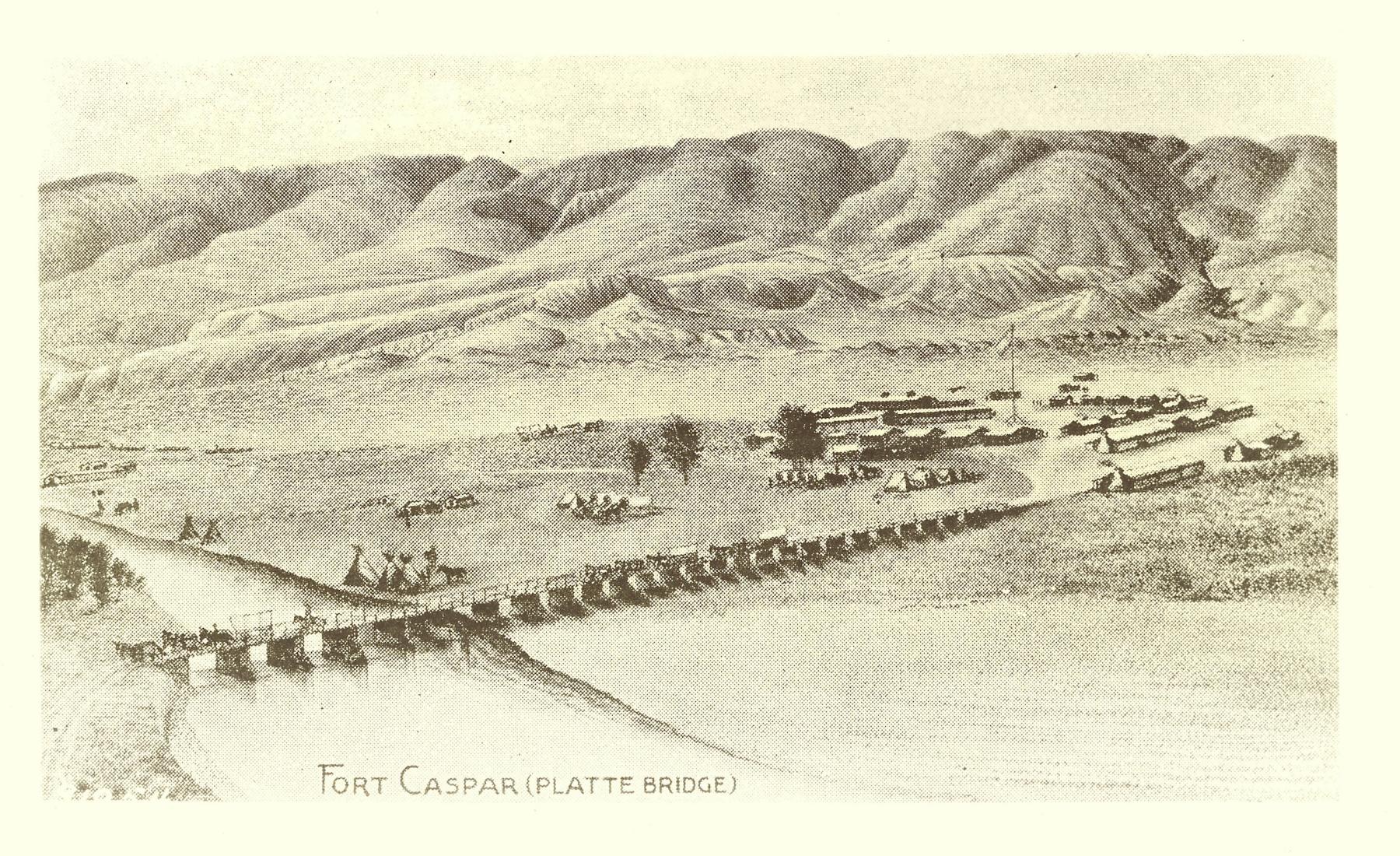
Figure. 2: An 1896 gelatin print of Fort Caspar, built at the site of Guinard’s Bridge once the Army took over the post, as depicted by artist William Henry Jackson. William Henry Jackson Collection, L. Tom Perry Special Collections, Harold B. Lee Library, Brigham Young University.
Guinard’s operation on the North Platte consisted of a small residence and store at the south end of the bridge, a timber structure 13 feet wide and 100 feet long, resting on stone-filled wood piers.23 The post itself was a long, low log building housing a trading house, living quarters, and the Pacific Telegraph Station.24 The exact layout and number of original buildings are unknown. The stage station stood nearby too, with its own log buildings and a corral, which one witness described as resembling a small, stockaded trading post.26
The site itself is complex, with multiple components besides the Guinard Post, including military and other commercial aspects. From 1858 to 1867, different buildings were constructed by multiple entities for a variety of purposes. Standing structures would be repurposed, as was the case with the Guinard Post and the telegraph station. Today, no existing buildings are present at the site, and it is possible any building associated with the Guinard occupation was cleared for contemporary construction projects, repurposed for building material, or disassembled with the rest of the buildings when the military relocated to Fort Fetterman. The possibility also exists that any remaining trading post buildings were destroyed with the bridge. The only remnants of the bridge are the bridge piers, which remain visible on the surface.27
Guinard’s Platte River Post is listed on the National Register of Historic Places as part of the Fort Caspar nomination. Archaeological investigations at the site have primarily focused on the military component. However, it is interesting to note data from the investigations conducted in the 1930s were used to reconstruct several buildings from the 1863 pre-military building episode.28 Even with the lack of archaeological investigations on the trading post itself, it is still considered a contributing property to the nomination based on the post’s involvement in fur trading and emigrant trading activities during the 19th century.29
Guinard himself did not linger to see any of this. After leaving the Platte River post, he is said to have run a ferry on the Green River for a time, prospected for gold in the South Pass country, and ranched near Lander, living to past 92 years of age before his death on March 24, 1912.30
[Editor’s Note: Special thanks to the author and to the Wyoming State Historic Preservation Office for making this article available, and to the Wyoming Cultural Trust Fund for its ongoing support for this project. Greg Pierce’s historical monograph, Negotiating the West: A History of Wyoming Trading Posts, from which this article is adapted and excerpted, is one of many historic contexts published by the Wyoming State Historic Preservation Office. These documents are meant to offer a broad background against which historic developments can be better understood as the agency works to preserve properties and places important to an understanding of Wyoming’s past. The contexts also, however, are based on sound research and are full of well-told, vivid stories. With this in mind, WyoHistory.org is collaborating with the SHPO office to bring more of this history to a wider readership. The Cultural Trust has provided the funds to make this collaboration possible. We offer our thanks to all.]
Footnotes
-
John D. McDermott, Frontier Crossroads: The History of Fort Caspar and the Upper Platte Crossing (Casper, WY: City of Casper, 1997), 23; Robert A. Murray, “Trading Posts, Forts, and Bridges of the Casper Area: Unraveling the Tangle on the Upper Platte,” Annals of Wyoming 47, no. 1 (1975): 18–19.
-
Jefferson Glass, “Reshaw’s Bridge,” WyoHistory.org, November 8, 2014, https://www..org/encyclopedia/reshaws-bridge.
-
Glass, “Reshaw’s Bridge.”
-
Robert A. Murray, “Trading Posts, Forts, and Bridges of the Casper Area: Unraveling the Tangle on the Upper Platte,” Annals of Wyoming 47, no. 1 (1975): 8, 19; Richard Burton, quoted in Murray, “Trading Posts, Forts, and Bridges,” 19.
-
David Eckles, Report of Archaeological Investigations at Richard’s Trading Post (Cheyenne: Wyoming State Historic Preservation Office, 1983), 18.
-
Olaf T. Hagen, “Platte Bridge Station and Fort Casper,” Annals of Wyoming 27, no. 1 (1955): 7.
-
Thomas A. Nicholas, “Frontier Duty Kept Troops Busy in Service,” Casper Star-Tribune, December 18, 1979, vertical file, Forts – Casper, Wyoming State Archives, Cheyenne. On Nicholas’s role in the 1963 archaeological work, see Murray, “Trading Posts, Forts, and Bridges of the Casper Area,” 5.
-
Ned Frost, Fort Caspar, National Register of Historic Places Inventory-Nomination Form, on file, National Register of Historic Places, National Park Service, Washington, DC, 1976, 2; John D. McDermott, “John Baptist Richard,” in The Mountain Men and Fur Trade of the Far West, ed. LeRoy R. Hafen, vol. 2 (Glendale, CA: Arthur H. Clark, 2000), 302.
-
Eckles, Report of Archaeological Investigations at Richard’s Trading Post, 21; Murray, “Trading Posts, Forts, and Bridges,” 20–21; Letters, Thomas Twiss, Upper Platte Indian Agency, to A. M. Robinson, Superintendent of Indian Affairs, October 10 and October 11, 1860, Upper Platte Agency Letters, National Archives, Washington, DC.
-
Letters, Thomas Twiss to A. M. Robinson, October 10 and 11, 1860, Upper Platte Agency Letters, National Archives, quoted in Murray, “Trading Posts, Forts, and Bridges,” 20; Richard Burton, quoted in Murray, “Trading Posts, Forts, and Bridges,” 19–20.
-
Murray, “Trading Posts, Forts, and Bridges,” 20; Deposition of Louis Richard, May 30, 1887, file 7868-123, Indian Claims Commission files, National Archives, Washington, DC.
-
Murray, “Trading Posts, Forts, and Bridges,” 24; Deposition of Louis Richard, May 30, 1887, file 7868-123; Ellis Hein, “The Battles of Platte Bridge Station and Red Buttes,” WyoHistory.org, November 8, 2014, https://www.wyohistory.org/encyclopedia/battles-platte-bridge-station-and-red-buttes.
-
Glass, “Reshaw’s Bridge;” Caspar Collins, ground plans of buildings at “Platte Bridge Station,” Special Collections, Colorado State University Library, Fort Collins, Colorado, n.d.; Murray, “Trading Posts, Forts, and Bridges,” 21.
-
Frost, Fort Caspar, 2.
-
Telegram, Capt. O. W. Van Winkle at Platte Bridge to Lt. Col. William O. Collins, Fort Laramie, October 27, 1862, RG98, National Archives, Washington, DC, quoted in Murray, “Trading Posts, Forts, and Bridges,” 23.
-
Murray, “Trading Posts, Forts, and Bridges,” 22–23.
-
John D. McDermott, “John Baptist Richard,” in The Mountain Men and the Fur Trade of the Far West, ed. LeRoy R. Hafen, vol. 2 (Glendale, CA: Arthur H. Clark, 2000), 296–300; Murray, “Trading Posts, Forts, and Bridges,” 17–18; Greg Pierce, “Richard’s Post,” WyoHistory.org, https://www.wyohistory.org/encyclopedia/richards-post.
-
Frost, Fort Caspar, 2.
-
Murray, “Trading Posts, Forts, and Bridges,” 25–27.
-
Murray, “Trading Posts, Forts, and Bridges,” 27.
-
Eckles, Report of Archaeological Investigations at Richard’s Trading Post, 29.
-
Murray, “Trading Posts, Forts, and Bridges,” 27–28.
-
Collins, ground plans, n.d.; Frost, Fort Caspar, 2; Murray, “Trading Posts, Forts, and Bridges,” 21.
-
Collins, ground plans, n.d.; Murray, “Trading Posts, Forts, and Bridges,” 21.
-
Collins, ground plans, n.d.; Murray, “Trading Posts, Forts, and Bridges,” 21.
-
Collins, ground plans, n.d.
-
Frost, Fort Caspar, 2.
-
Frost, Fort Caspar, 2.
-
Frost, Fort Caspar, 9.
-
Francis Seely Webb, “Bridge Builder’s Granddaughters Visit Site,” Casper Star-Tribune, Annual Wyoming Edition, March 1964; Guinard obituary, Bill Judge files, Fort Caspar, quoted in Murray, “Trading Posts, Forts, and Bridges,” 20.