From 1850 to 1854, fur trader and interpreter Joseph Bissonette ran an independent trading post on the North Platte River, serving emigrants and Lakota bands alike. He later worked as a ferryman, bridge partner, and government official through the Oregon Trail’s final violent years.

Fur trader Joseph Bissonette built a bustling trading post at the mouth of Deer Creek in 1857—a crossroads of commerce, diplomacy and scandal that hosted Lutheran missionaries, Pony Express riders and a wary military garrison before Indian wars reduced it to ashes in 1865.

In 1852, Charles Lajeunesse built a trading post at Devil’s Gate, funneling all Sweetwater Valley emigrant traffic past his door. Abandoned by 1856, its ruins sheltered the stranded Martin Handcart Company that winter. Lost for a century, the site was rediscovered and rebuilt in 2001.

Along the Sweetwater River near Independence Rock, Archambault’s Post traded with emigrants and Native peoples through the 1850s, its history tangled with the neighboring Seminoe’s Post. Abandoned by 1856, it briefly sheltered Mormon handcart emigrants stranded that fall in a killing snowstorm.

Savino C. Lopez arrived in Cheyenne in 1943 after years as a farmer and labor organizer in New Mexico, Colorado, and South Dakota. In Wyoming, he founded and led a network of Latin American organizations that fought for civil rights and political recognition from 1948 until his death in 1978.

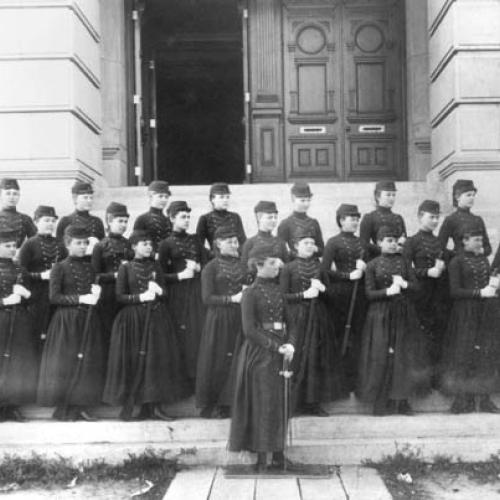
Memories of a 1990 Girl Guard

Modern military women, trained by one of the most sophisticated armed forces in the world, marching in 19th-century caps and ankle-length skirts with wooden rifles in white-gloved hands. That was the Wyoming Girl Guard, organized in the late 1980s for the 1990 statehood centennial and still active more than 30 years later. In this sidebar from Cowboy Soldiers: The History of the Wyoming National Guard, Volume 1, 1870-1945, Rosalind Routt Schliske remembers the contrasts, the parades, and the day she stood near the Esther Hobart Morris statue with a front-row view of history.
The New Deal split Wyoming's federal policy in two. In the west, the Taylor Grazing Act of 1934 brought public range under federal regulation, creating grazing districts and permits that permanently reshaped grazing rights. In the east, federal programs deemed homesteaded Great Plains land unfit for farming and worked to resettle its residents.

When the New Deal arrived in Wyoming in the 1930s, federal agents fanned out across the state buying and slaughtering cattle and reducing crops to combat the Depression-era crisis of overproduction. This article examines how the Agricultural Adjustment Administration’s production controls played out on Wyoming’s ranches and farms.

When the stock market crashed in 1929, Wyoming’s farms and ranches were already struggling. Collapsing markets, failing banks, and drought pushed the state’s agriculture to the breaking point. Roosevelt’s New Deal offered relief, but also brought federal power into Wyoming’s rangeland, permanently reshaping ranchers’ relationship to the land.

In January 1966, James W. “Jim” Byrd became the first Black police chief in Cheyenne—and in Wyoming. Over a 25-year career he helped modernize the Cheyenne Police Department and went on to serve as a Wyoming highway safety director and U.S. Marshal. Read more about this quiet trailblazer in Wyoming public life.