Bordeaux’s Sarpy Point Post
In 1849, the United States Army purchased Fort John, the American Fur Company’s long-dominant post near the confluence of the Laramie and North Platte rivers and converted it into the military installation known as Fort Laramie. That transaction dissolved the commercial monopoly the company had maintained in the region for nearly a decade and opened the North Platte valley to independent traders eager to profit from the booming emigrant traffic on the Oregon, California, and Mormon trails.
Among the first to take advantage of the opportunity was James Bordeaux, a veteran company employee who had managed Fort John itself. Between 1849 and 1868, Bordeaux operated a trading post on a low terrace along the south bank of the North Platte, eight miles downstream from the former Fort John. It served both the Brulé Lakota and Oglala Lakota bands who frequented the valley and the tens of thousands of emigrants who passed its door each season.
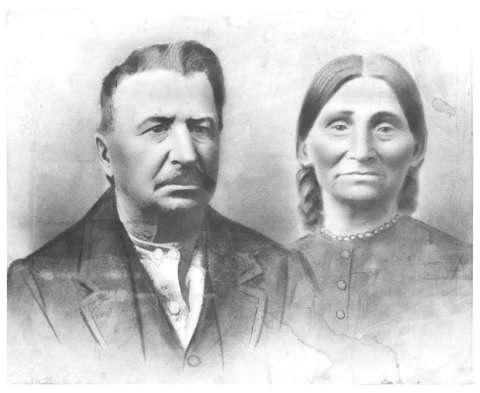
James Bordeaux and the North Platte Trade
James Bordeaux was born around 1814, the son of a French family from the region near St. Louis, Missouri. He entered the fur trade at approximately twelve years of age in 1826, gaining employment on an American Fur Company expedition on the Missouri River. He remained in the company’s service for more than two decades, eventually rising to the post of trader at Fort John, where he developed close ties with the Brulé Lakota, including through marriage into the tribe. His fluency in Lakota and his reputation for fair dealing made him one of the most trusted Euro-American figures in the North Platte valley during the 1840s and 1850s.
With the sale of Fort John in April 1849, Bordeaux became an independent trader. He initially occupied a wintering post he had established in 1846, while still employed at Fort John, on the White River near modern Chadron, Nebraska. Later that year, or early in 1850, he constructed a second and more commercially important establishment on the North Platte itself. That post, positioned on a low terrace on the southern bank of the river, became the center of his trading operations for the better part of the next two decades.
The Post and Its Trade
Bordeaux’s Sarpy Point Post occupied a site near a prominent bend in the North Platte long known as Sarpy’s Point. The point took its name from Peter l’Abadie Sarpy, who had built a short-lived trading post there in 1837–1838; Fort John itself had been named for a different member of the Sarpy family, the American Fur Company partner John B. Sarpy. The White River post that Bordeaux operated simultaneously focused almost exclusively on the buffalo robe trade with the Brulé Lakota, while the Sarpy Point Post pursued a dual economy, combining the native robe trade with active commerce directed at the emigrant trains filing past along the south bank of the North Platte. By the mid-1850s, small trading operations dotted the North Platte roughly every fifteen to twenty miles, and the Sarpy Point Post was among the most durable of these establishments.
The post’s physical form is only partially documented. Contemporary and near-contemporary accounts describe it as an un-stockaded log structure comprising at minimum a trading house, a storehouse, and a cellar. Captain Eugene F. Ware of the Seventh Iowa Volunteer Cavalry, who visited the site in 1864, noted the presence of the cellar, which remained intact beneath a layer of later topsoil when archaeologists examined the site in the 1980s. Bordeaux also engaged in livestock trading—dealing in cattle, pigs, chickens, and horses—which suggests the likely presence of stables, corrals, or animal pens, though no structural evidence for these features has been confirmed archaeologically.
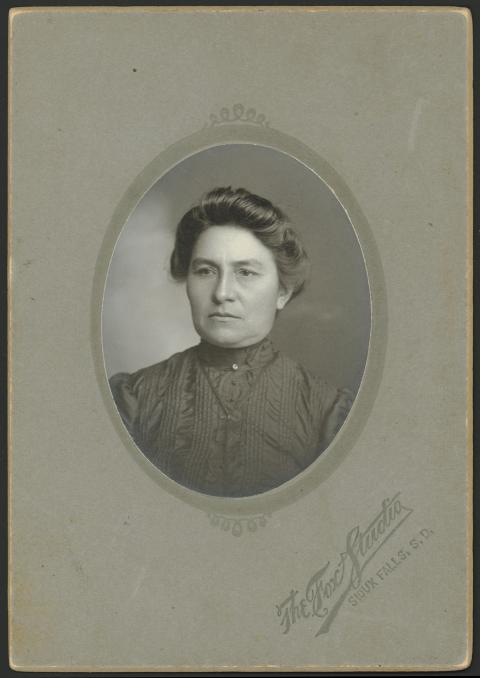
Susan Bordeaux Bettelyoun, Bordeaux’s daughter by his Brulé Lakota wife, left a detailed first-hand account of life at the post. She described emigrants trading exhausted horses and offloading surplus furniture—marble-topped tables, bureaus, and carved chairs—that made their way into the log cabins of traders and neighbors along the trail. Her account captures both the commercial texture of the post’s operation and the social world it sustained, one in which Lakota families camped nearby, fiddle music was a regular feature of evenings, and the boundary between the trading post’s Euro-American commerce and the rhythms of Lakota life was permeable in both directions.
Bordeaux was not alone in exploiting the commercial possibilities of Sarpy’s Point. Shortly after he established himself there, he entered a brief association with Joseph Bissonette and Charles Primeau, the three men operating together from approximately 1849 to 1850 before the arrangement dissolved. Bissonette subsequently relocated to a post of his own approximately three miles upriver and, for several years, ran a competing operation that also serviced emigrant traffic and maintained relations with the Lakota. The clustering of these posts near Sarpy’s Point reflects the location’s strategic importance: it offered reliable river access, proximity to established Lakota camps, and position on the main emigrant road before travelers reached the former Fort John and the military presence there.
The Grattan Fight of August 19, 1854
The most consequential event in the history of the Sarpy Point Post—and a significant one in the broader history of Wyoming—took place on August 19, 1854, when a confrontation between a detachment of U.S. Army soldiers and a large encampment of Brulé and Miniconjou Lakota camped near the post escalated into the fight that became known as the Grattan Fight, or, in older usage, the Grattan Massacre. The incident is commonly regarded as the opening engagement of the First Sioux War and the beginning of nearly four decades of intermittent armed conflict between the United States and the Lakota and their allies on the northern Plains.
In the late summer of 1854, an estimated four thousand Brulé and Oglala Lakota were camped along the North Platte east of Fort Laramie, awaiting the distribution of annuity goods guaranteed by the Fort Laramie Treaty of 1851. On August 18, a visiting Miniconjou man named High Forehead killed a stray cow belonging to a Mormon emigrant party. The cow’s owner demanded twenty-five dollars in compensation, a demand Brulé head chief Conquering Bear sought to resolve by offering horses from his own herd. The offer was refused, and Lieutenant Hugh Fleming, commanding the undermanned Fort Laramie garrison, asked Conquering Bear to surrender High Forehead, a request the chief declined, explaining that the Miniconjou visitor was not subject to his authority.
The following afternoon, Brevet Second Lieutenant John L. Grattan led a detachment of twenty-nine soldiers and a civilian interpreter, Lucien Auguste, out of the fort and down the North Platte Road toward the Lakota encampment. The soldiers stopped first at the Gratiot Houses trading operation and then at Bordeaux’s Sarpy Point Post, which stood approximately three hundred yards from Conquering Bear’s lodge. Auguste, who had already been drinking and who was regarded by many in the area, both Native and Euro-American, as reckless and antagonistic, continued to taunt the Lakota present at Bordeaux’s post. Bordeaux, who spoke Lakota fluently, attempted to defuse the situation. Conquering Bear sought to recruit Bordeaux as an interpreter to replace the unreliable Auguste but was unable to do so before the confrontation escalated.
Grattan moved his troops into position in front of Conquering Bear’s lodge and, after additional negotiations failed, ordered his men to fire. Grapeshot from the two howitzers passed high, striking only the tops of lodge poles. Warriors surrounding the detachment returned fire immediately; the engagement lasted approximately ten minutes. Grattan, Auguste, and all twenty-nine enlisted men were killed. Conquering Bear, shot three times, died several days later. Bordeaux later reported that he witnessed the first shot fired by the soldiers and that, by the time the Lakota warriors had taken up flanking positions around the detachment, the outcome was no longer in doubt.
In the aftermath, Lakota warriors raided the trading posts along the North Platte, carrying off both the government annuity goods stored at a nearby storehouse and the trade goods held by independent merchants in the area, including Bordeaux’s. Bordeaux himself was unharmed; his Lakota kinship connections and his long-standing reputation for fair dealing protected his person even as his stock was confiscated along with the rest. The following summer, General William S. Harney led a punitive expedition that destroyed a Lakota village at Ash Hollow, Nebraska, in what became known as the Battle of Blue Water Creek or the Harney Massacre—an attack in which the majority of the dead were women and children—before pushing further into Lakota territory. These events, taken together, mark the beginning of a generation of intensifying conflict on the northern Plains.
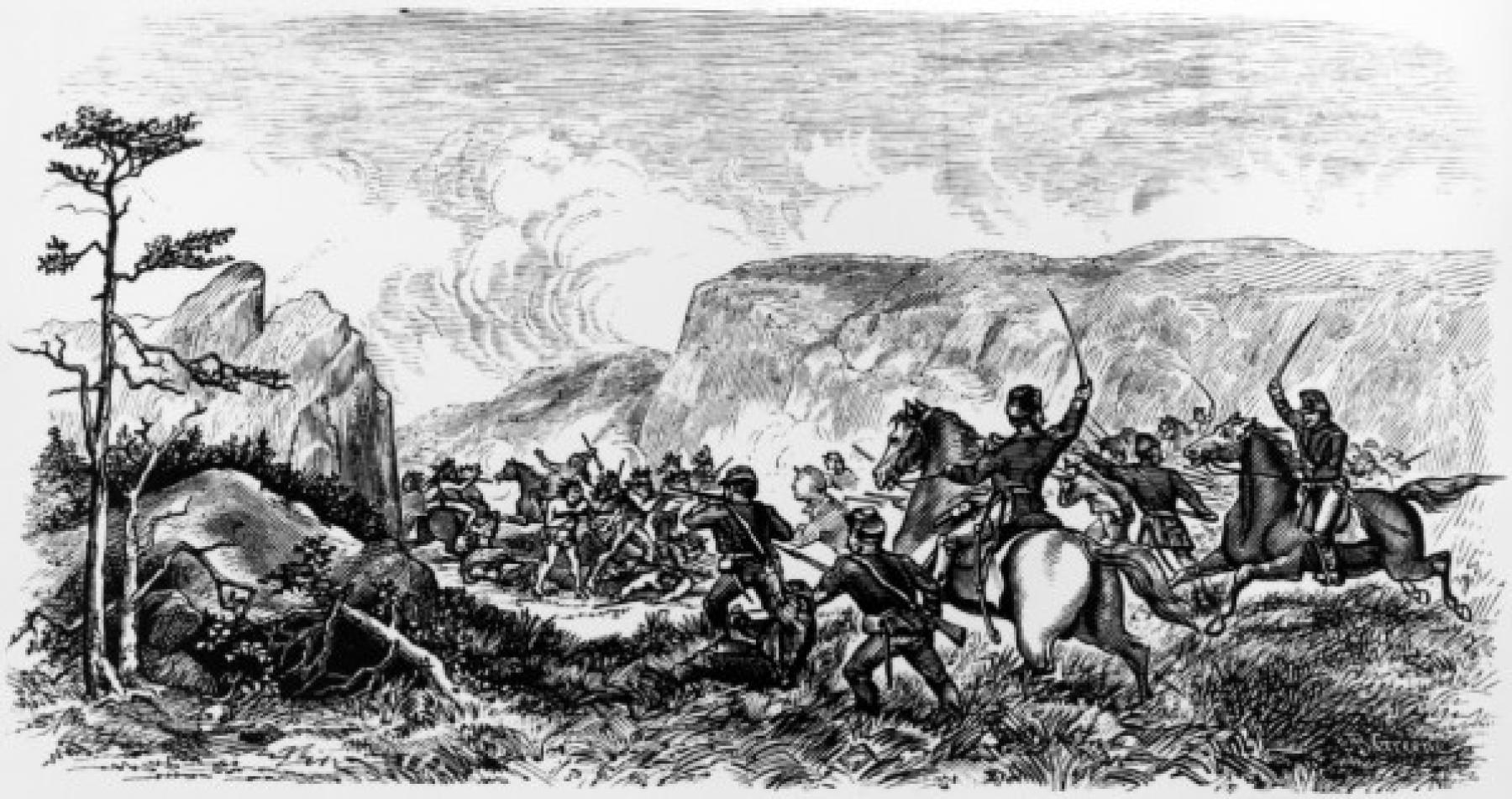
Historians have debated the precise responsibility for the Grattan Fight. Some scholars, following the initial War Department interpretation, framed the event primarily as an act of Lakota aggression. Others, examining the treaty context more carefully, have emphasized that the 1851 Fort Laramie Treaty explicitly reserved the handling of such disputes to the civilian Indian agent. That agent was due to arrive within days carrying the very annuity goods the Lakota were awaiting, which made Grattan’s intervention, in this view, a violation of the treaty’s terms. Contemporary accounts, including Bordeaux’s own testimony, consistently place the first shot with Grattan’s command.
Later Operations and Abandonment
The Grattan Fight did not end Bordeaux’s operations at Sarpy’s Point. He continued to trade from the North Platte post throughout the late 1850s and into the 1860s, adapting to the shifting conditions of the Plains trade. In 1862, he constructed a second outpost at Rawhide Buttes, located 12 miles south of present-day Lusk, Wyoming. In 1867, he established a store at the junction of the new military roads connecting Fort Laramie with Fort D.A. Russell and Fort Fetterman with Fort D.A. Russell, responding to the commercial opportunities created by the expansion of the military road network. Captain Ware’s correspondence indicates that the Sarpy Point Post was still operational as late as 1864.
The second half of the 1860s proved increasingly difficult for independent traders on the North Platte. The intensification of conflict between the United States and the Lakota and their allies during Red Cloud’s War (1866–1868) made trading both dangerous and unprofitable, and the sharp decline in emigrant traffic following the completion of the transcontinental railroad in 1869 further undercut the economic model that had sustained posts like Bordeaux’s for two decades. The establishment of Indian agencies also transformed the commercial landscape: rather than traveling to independent trading posts, Lakota bands were increasingly directed to agency stores, and the federal government offered employment to traders with Native language skills and cultural knowledge. Taking advantage of his Lakota connections and his long experience, Bordeaux relocated to the Whetstone Agency in present-day South Dakota in 1868, leaving his North Platte post behind. That move marks the latest documented date of Bordeaux’s presence on the North Platte and the probable end of regular operations at Sarpy’s Point. Bordeaux died of pneumonia in 1878.
Locating the Post
The precise location of the Sarpy’s Point Post was not definitively fixed during the nineteenth century and has presented challenges for later researchers. The general area was recognized in 1953 when the Wyoming Historical Landmark Commission placed a marker on State Highway 157 near Lingle, Goshen County, to commemorate the site of the Grattan Fight, which took place adjacent to Bordeaux’s post. The property itself has long been agricultural land, a circumstance that has both damaged and inadvertently revealed portions of the site.
In 1980, a landowner was leveling a field for farming when he exposed artifacts and human remains, accidentally revealing what the historical record had left unresolved for over a century. Archaeologist George Zeimens, working with a group of local avocational archaeologists, conducted emergency excavations at the site. The excavations confirmed the presence of a post cemetery containing both Euro-American and Lakota burials, a physical trace of the mixed community that had gathered at Bordeaux’s post for two decades. A separate 1984 study examined one of those burials in detail: a Euro-American man whose remains showed evidence of gunshot wounds, buried among well-preserved personal effects within a broader Lakota burial ground associated with the post, a final testament to how thoroughly the lives of traders and Lakota families at Sarpy’s Point had become intertwined.
Significance
Bordeaux’s Sarpy Point Post illustrates the transformation of the North Platte valley trade in the two decades after the American Fur Company’s departure. Where the pre-1849 era had been defined by the dominance of a single corporate entity and the primacy of the beaver pelt and buffalo robe trades, the period after 1849 was characterized by a proliferation of small, entrepreneurially nimble independent posts competing for both the Lakota robe trade and the emigrant market. The Sarpy Point Post was among the most resilient of these establishments, surviving long after many contemporaries had failed or been absorbed.
The post’s position near the site of the Grattan Fight gives it a singular place in Wyoming history. Bordeaux was a direct witness to an event that historians have repeatedly identified as the opening of the northern Plains Wars, and his testimony remains among the most detailed first-person records of the confrontation. His survival, owed in significant part to his Lakota kinship ties, illustrates the degree to which successful traders of the period were embedded in Native social networks rather than standing apart from them.